
Nvidia’s $1 Trillion Test: Known Knowns and Unknown Unknowns
Editorial Note: Deep Dive first pass report compiled November 12, 2026.
Why the real test for Nvidia isn’t FY 2027 or 2028 revenue growth, it’s how the company navigates over
$1 trillion in hard and soft commitments.
When evaluating Nvidia, most investors are looking through the wrong lens. Obsessing over the next two fiscal years misses the bigger picture: commitments for FY 2027 and FY 2028 are already signed, and Nvidia’s near-term trajectory is well-protected as revenue and demand continue to match its massive scale.
The critical timeframe for valuing Nvidia is 3 to 6 years out. To get there unscathed, management has roughly one year to figure out its strategic "Unknown Unknowns" and one year to execute. The clock is ticking, and every second matters.
Breaking down Nvidia’s off-balance sheet commitments reveals interesting insights for investors and AI industry analysts:
- Known Knowns: $530.5B in Locked-In (hard) off balance sheet commitments Anomaly:
Identified by our
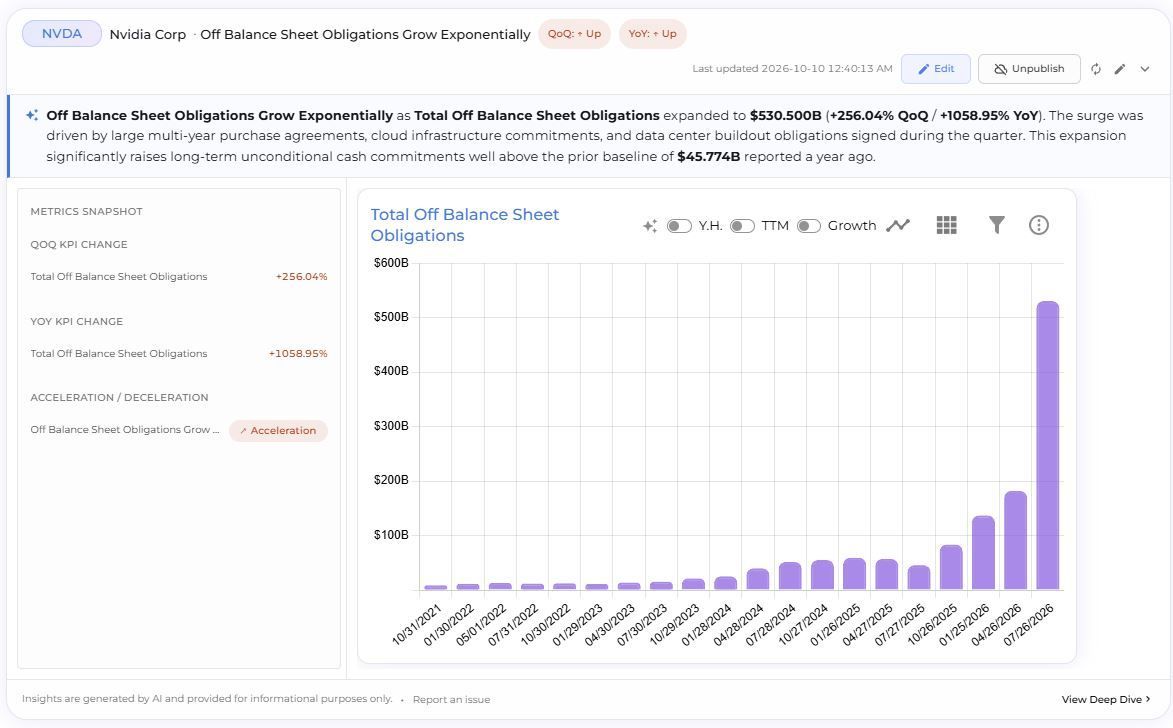
Deep Dive analysis, the hard numbers on Nvidia’s previous 10-Q show an unprecedented scaling of long-term financial commitments. Nvidia’s total off-balance sheet commitments (that must be honored) have surged to
$530.5 billion, representing a
256% increase quarter-over-quarter and a staggering
1,059% jump year-over-year. Tracked across 14 distinct variables on Ubineer Deep Dive and Feeds, this surge was driven by massive multi-year purchase agreements, cloud infrastructure commitments, and data center buildout obligations signed during the quarter. To put that velocity into perspective, Nvidia’s unconditional long-term cash commitments stood at a baseline of just
$45.77 billion a year ago. These obligations are locked in, creating a towering floor of future cash outflows that must be met with sustained ecosystem demand.
Source: Ubineer Feed 2026-10-10 12:40:13 ET
2.
Known Unknowns: $500B+ in Non-Binding Deals (soft)
Balancing those hard obligations is a massive, yet fragile, financing mechanism. As disclosed in Nvidia’s August 2026 SEC filing, the company entered into memorandums of understanding (MOUs) with several large capital providers to establish independent financing platforms designed to mobilize more than $500 billion in third-party capital.
"In August 2026, we entered into memorandums of understanding with several large capital providers to establish independent financing platforms designed to mobilize more than $500 billion of third-party capital over time to support the deployment of AI infrastructure. These and other preliminary arrangements may not lead to definitive agreements. These arrangements are designed for our ecosystem partners and customers to build and gain access to AI infrastructure with the corresponding funding structures independently underwritten and provided by the capital providers. At our option, we may provide limited residual-value support for a portion of specific projects, subject to disciplined risk management and project-by-project evaluation."
— Nvidia Corp., SEC Form 10-Q (Period Ended July 26, 2026)
Here is the catch: these arrangements are explicitly non-binding. Among all the variables in Nvidia’s financial outlook, this $500B+ line item carries the highest risk of vanishing. Without CEO Jensen Huang’s personal deal-making involvement to shepherd these MOUs into definitive agreements, there is no guarantee this capital actually materializes.
3. Soon-to-Be Knowns: What’s Changed Since August
Because the SEC disclosures reflect the landscape as of August 2026, the immediate blind spot for the market is velocity. The next major catalyst for institutional investors will be seeing the exact extent to which both buckets — the
$530.5 billion in hard off-balance sheet obligations and the
$500 billion+ in soft financing MOUs — have expanded, contracted, or converted into definitive deals over the subsequent months.
4. Unknown Unknowns: Who Funds the Ecosystem Next?
The core question for valuing Nvidia over a 3-to-6-year horizon comes down to its future strategy regarding items 1 and 2.
The semiconductor and AI infrastructure ecosystem requires immense liquidity to scale at its current breakneck pace. Up to this point, Nvidia has effectively acted as the industry's liquidity pressure valve, absorbing risk and lubricating growth across four critical pillars:
- Neoclouds: Fueling infrastructure buildouts and GPU demand.
- AI Startups: Supporting emerging compute consumers.
- Open Source Ecosystems: Driving broad software adoption and ecosystem lock-in.
- Suppliers: Guaranteeing capacity across the physical supply chain.
The ultimate "Unknown Unknown" is how Nvidia plans to transition away from carrying this liquidity burden on its own shoulders. While FY 2027 and FY 2028 are largely secured, Nvidia has a narrow 24-month window to convert non-binding third-party capital into a self-sustaining engine — without choking off the very demand that justifies its valuation.
Ultimately, Nvidia’s $1 trillion test is a race against the clock. Whoever steps in as the next CEO, their most important strategic decision will be how to support the entire AI ecosystem — because while investors gave Jensen Huang a blank check, his successor will not have that luxury and will have to rely much more heavily on public and private markets.
On paper, $500 billion+ in non-binding MOUs might seem modest until you account for the ecosystem leveraging that capital by ~2–4x, whereas the $530.5 billion in hard off-balance sheet obligations could be leveraged 5–8x over.
Without Jensen’s halo to hold those deals together, turning soft commitments into hard liquidity is now the single biggest risk to Nvidia's long-term growth and the AI bull market build-out.
Want our buy-side institutional Census AI and Predictions estimates for Nvidia? Click or tap the Download Full Report button below or ask us about our product lineup.
The Ubineer Advantage
Ubineer's predictive technology offers immediate tangible benefits for portfolio managers, analysts and chief investment officers, allowing them to:
- Anticipate the Fundamental Future: Obtain an accurate model of a company's performance with a forward view of up to five quarters.
- Expect the "Guide": Accurately predict management's future outlook, enabling portfolio managers to set independent targets.
- Set a Thesis Margin: Supply an "80% Confidence Interval" for critical metrics like Revenue, Operating Income, and Free Cash Flow, which helps validate or challenge the investment thesis.
Institutional investors are encouraged to contact Ubineer for a personal demonstration of the company's software products and capabilities. We invite you to enquire about companies we currently cover or let us know a publicly traded company you’re interested in or misjudged.

Ubineer is a leader in high-trust AI-driven predictive software that helps professional fund managers succeed.
We invite you to reach out with your questions. Ubineer can provide proven solutions to some of your most pressing needs.
Ask us about Deep Dive
Thank you for contacting us. We will get back to you as soon as possible.
Oops, there was an error sending your message. Please try again later.
Messages to Ubineer are encrypted for your privacy and security.